
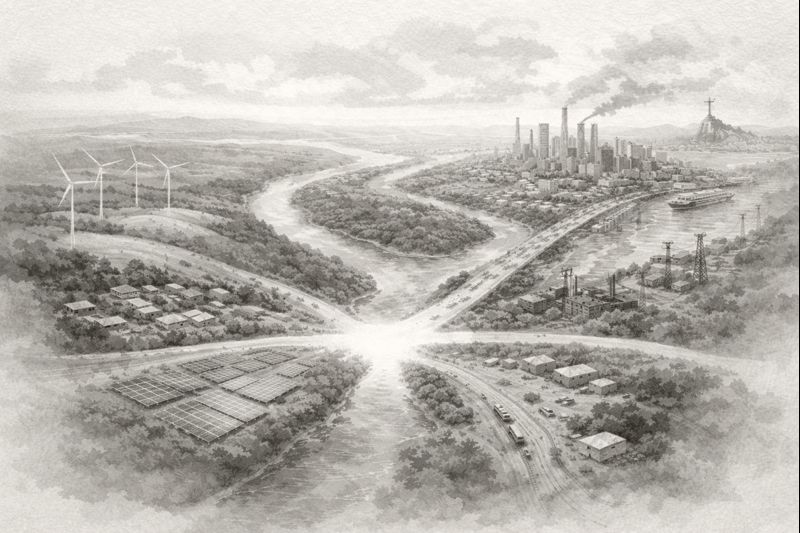
From Uniform Transition to Managing Divergent Pathways
COP30 marked a shift that many observers only partially grasped: the definitive end of the illusion of a globally coordinated, uniform climate transition as envisioned in the post-Paris era.
This wasn’t a declared rupture, nor a formalized failure. It was something sharper and, paradoxically, more instructive: a collective acknowledgment, implicit yet unmistakable, that the international climate system now operates in a polycentric, fragmented reality.
What emerged in Belém wasn’t simply an ambition deficit—it was political certification of a structural fact already evident: different actors are pursuing different transitions, at different speeds, with different tools and, crucially, with fundamentally different conceptions of what “transition” means. COP30 didn’t attempt to artificially reconcile this divergence. It absorbed it.
This represents one of the most significant outcomes of the entire process, however paradoxical.
The Structural Fracture: From Latent to Declared
In recent COP cycles, fragmentation was largely masked by unifying language. At COP30, this fiction began to crack. Traditional “climate powers” appeared divided and less capable of shaping the overall narrative, while Global South countries and emerging blocs demonstrated greater strategic coherence and negotiating confidence.
India represents the most emblematic case. Its position has been explicit and consistent: transition is legitimate only if development-led. The message, reiterated without ambiguity, is that asking economies with limited historical responsibility to replicate the decarbonization path of countries that built prosperity on two centuries of fossil fuels is neither politically nor economically sustainable. This isn’t tactical obstruction—it’s a structured narrative combining economic growth, energy security, and gradual transition, backed by broad domestic consensus.
At the opposite extreme, Gulf petrostates adopted an equally coherent strategy but with diametrically different objectives: active defense of the energy status quo. Systematic blocking of explicit references to fossil fuel phase-out in the final text wasn’t a negotiating accident—it was deliberate policy. Russia, while supporting some multilateral development bank reforms, did so on terms compatible with preserving its energy interests.
The European Union, for its part, isn’t absent or irrelevant. It continued leading a broad coalition—over eighty countries—supporting a roadmap for transitioning from fossil fuels. However, this coalition’s relative weight appeared less than European expectations and less capable of imposing a shared trajectory. Ambition remains high, but collides with eroding industrial competitiveness and growing fragmentation of domestic political consensus. Rather than isolated, Europe appears weakened in its role as global norm-setter.
Divergent Pathways Now Explicit
One of COP30’s most revealing features is that in real dynamics and backstage negotiations, few actors still believe in a single global transition pathway. Formal decision language maintains this fiction partly for obvious diplomatic reasons. But beneath the surface, three distinct trajectories have emerged clearly.
High-Ambition Coalition
(European Union, United Kingdom, Small Island Developing States, some Latin American countries)
This coalition continues pushing for fossil fuel phase-out, 1.5°C-compatible trajectories, and mid-century climate neutrality. However, it does so from a position of growing economic and political vulnerability, struggling to translate normative ambition into industrial leadership and international consensus.
“Development-First” Coalition
(India, many African countries, parts of Asia)
Here, decarbonization is subordinated to clear conditions: predictable finance, technology transfer, absence of debt-generating instruments. The message is pragmatic: without these preconditions, transition will happen anyway, but according to national timelines and modalities compatible with development objectives and social stability.
Defensive Fossil Coalition
(Petrostates, Russia, and more ambiguously China)
This trajectory doesn’t formally deny transition but works to slow and dilute it, maintaining a central role for gas and oil as “transition fuels.” China’s position remains deliberately ambivalent, oscillating between industrial leadership in clean technologies and defense of coal-based energy security.
Belém’s Compromise: Institutionalizing Fragmentation
COP30’s deepest political significance lies in the mechanisms adopted. All share a fundamental characteristic: they’re voluntary, cooperative, and non-binding. The lexicon used—”encourage,” “facilitate,” “support”—is a clear diplomatic signal: there’s no longer any pretence of uniform collective discipline.
Rather than forcing artificial consensus on global roadmaps for fossils and deforestation, the Brazilian presidency promoted voluntary initiatives and thematic platforms. Operationally, this amounts to recognizing that climate multilateralism is evolving toward a model of coalitions of the willing rather than binding global coordination.
Why This Represents Imperfect Progress
Defining this shift as progress invites legitimate criticism: it can be read as surrender masked as realism, or as normalizing multilateralism’s failure. This reading is understandable. However, compared to the alternative—maintaining a paralyzing illusion—this outcome can be interpreted as a second-best result, preferable to immobility but certainly inferior to the optimum of functioning multilateralism.
First, for analytical honesty. Continuing to claim all countries were converging toward the same objectives with the same tools had become untenable. National contributions already demonstrated this. Recognizing there’s no unified global plan, but rather a constellation of national approaches, at least allows working on realistic foundations.
Moreover, this recognition liberates functional coalitions. High-ambition countries are no longer forced to await petrostate consensus before experimenting and accelerating. Minilateralism isn’t a panacea but may prove more effective than blocked multilateralism.
Finally, it makes the principle of common but differentiated responsibilities genuinely operational. No longer rhetorical formula, but foundation for financial and technological instruments truly adapted to different starting points.
Real, Not Theoretical, Risks of Fragmentation
This evolution isn’t risk-free. A race to the bottom on environmental standards is already visible, particularly in energy-intensive manufacturing sectors. Free-riding by major emitters remains an unresolved systemic problem. Proliferation of unilateral instruments—including climate-linked trade measures—increases risks of regulatory fragmentation and geopolitical tensions masked as climate policy.
To these political and economic risks, add an elephant in the room: aggregate climate implications. If the three coalitions proceed along divergent trajectories, the plausible result is an emissions pathway incompatible with 1.5°C and probably closer to scenarios in the 2–2.5°C range in the medium term, with risks of further slippage absent significant acceleration. Pragmatism has limits: climate physics doesn’t negotiate.
Operational Implications for Policymakers and Financial Institutions
For actors like European institutions and multilateral development banks, COP30’s message is unequivocal: it’s no longer possible to operate assuming a coherent multilateral framework toward which everyone converges.
This implies the necessity to:
- Develop differentiated support models adapted to specific national contexts
- Build functional coalitions rather than awaiting universal consensus
- Accept coexistence of divergent narratives, investing in finance and technology transfer rather than moral persuasion
Europe will hardly convince India its pathway is wrong. But it can make accelerated decarbonization more attractive through coherent economic, industrial, and financial instruments.
Conclusions
The key question is no longer “how do we all do the same thing together?” but “how do we coordinate different pathways to avoid the worst climate and geopolitical outcomes?”
COP30 didn’t answer this question.
But for the first time, it posed it without pretending the answer was simple. And today, that’s already a step forward.